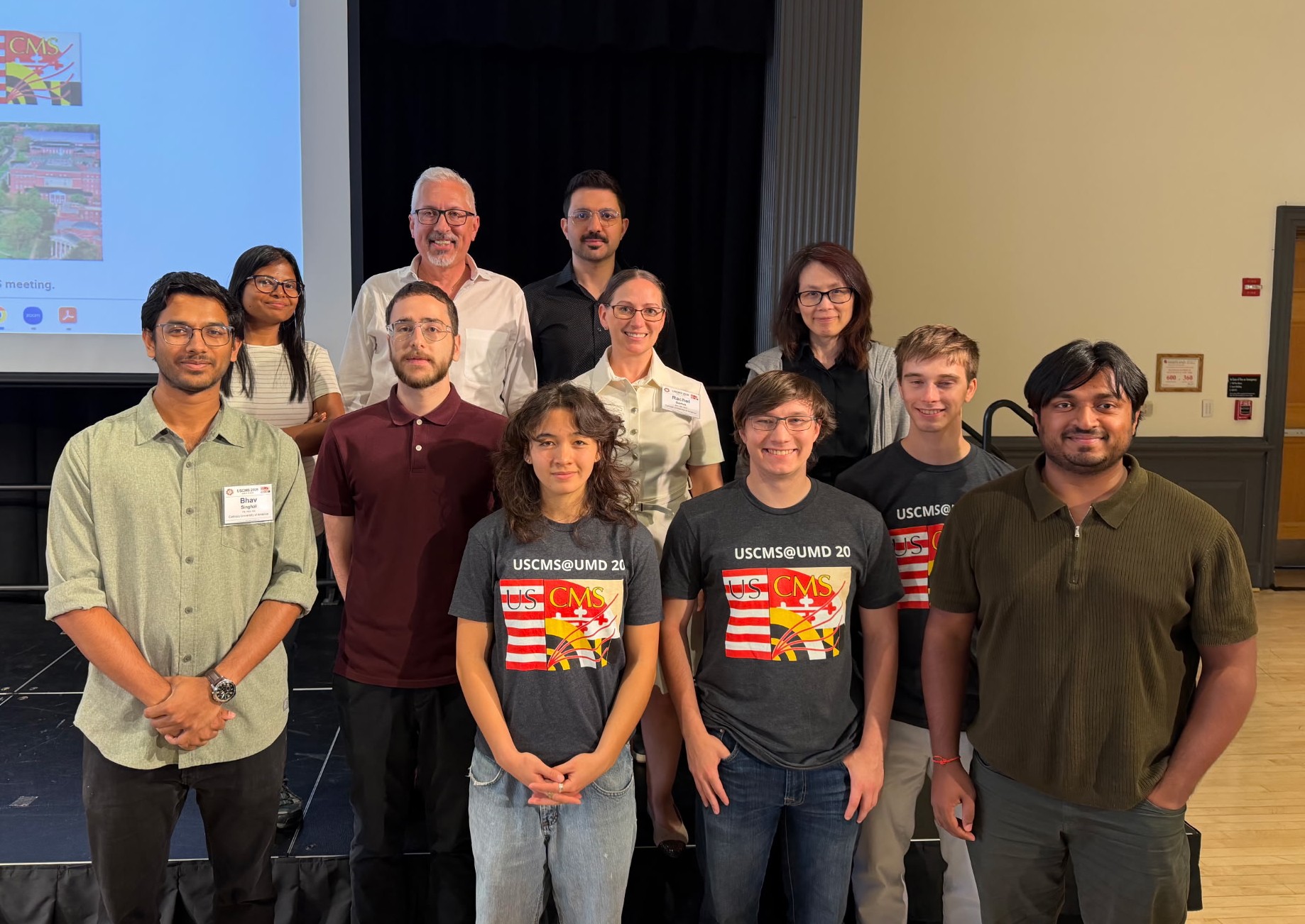
 The High Energy Physics (HEP) Group within the Department of Physics recently represented Catholic University at the 2026 U.S. Compact Muon Solenoid (CMS) Annual Collaboration Meeting, hosted at the University of Maryland, College Park. The conference serves as a vital forum for researchers to discuss plans for upgrading the CMS detector, projected funding, and the latest analysis results from U.S. institutions working on the CMS experiment at CERN's Large Hadron Collider (LHC). The event also offers a prime opportunity for U.S.-based researchers to connect and collaborate.
The Catholic University delegation was led by Dr. Aaron Dominguez—Executive Vice President, Provost, and Ordinary Professor of Physics—who is an expert in high-energy and particle physics. Associate Research Professors Dr. Rachel Bartek and Dr. Shin-Shan Eiko Yu also attended, both lending their expertise as lead session organizers.
Additionally, several postdoctoral researchers and students from the Department of Physics joined the delegation to showcase the University's next generation of scientific research. Dr. Ali Eren Simsek delivered two talks: one detailing the HEP Group’s "Tracker Forward Pixel Detector" project and another reporting on the Fermilab Users & Affiliates Executive Committee. Meanwhile, Dr. Bisnupriya Sahu, along with graduate and undergraduate students, presented research posters on advanced data analysis, the group's ongoing search for new fundamental particles, and the technical assembly of advanced detector components. The presentations provided valuable opportunities for students and researchers to share their work, engage with other experts in the field, and strengthen collaborative connections within the CMS community.
Beyond the technical presentations, attendees participated in a session led by the CMS experiment management team, an artificial intelligence in (AI) hands-on workshop, and a popular alumni career panel exploring professional paths outside of academia.
The College of Engineering, Physics, and Computing is proud to recognize the continued contributions of its researchers to high-energy and particle physics and their commitment to the international collaborations that drive scientific discovery and innovation.
