

The Sun is constantly releasing streams of charged particles into space. When these particles, known as solar wind, interact with Earth’s magnetic environment, they can create geomagnetic storms—powerful space weather events that scientists study to better understand the connection between the Sun and our planet.
Dr. Nithin Sivadas, a research scientist at The Catholic University of America who works in the Space Weather Laboratory at NASA's Goddard Space Flight Center, is advancing our understanding of these extreme events through new research published in Nature. His paper, “Regression to the Mean Can Explain Saturation of Geomagnetic Storms,” examines a long-standing question about how Earth responds to the strongest solar wind conditions.
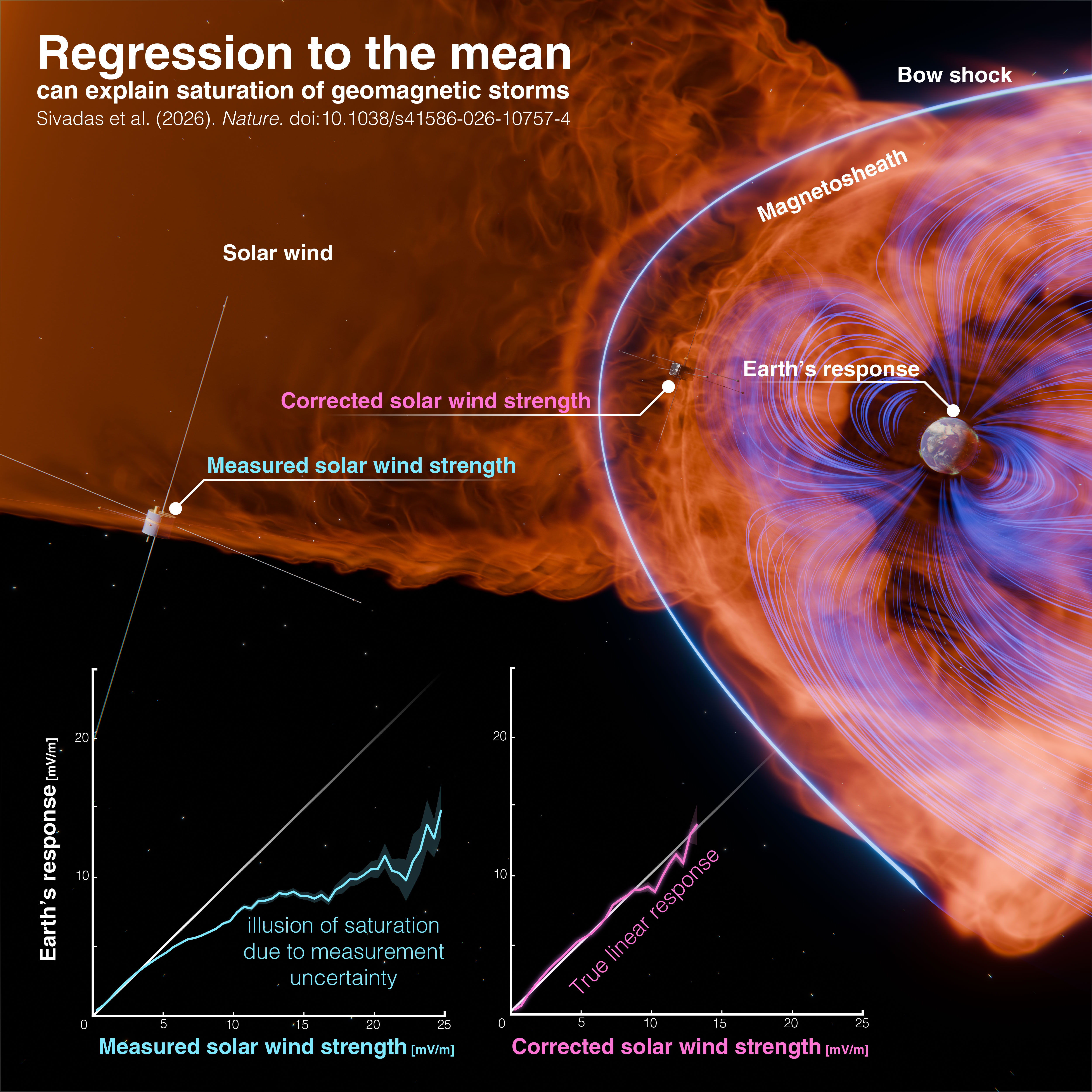
For years, scientists observed that Earth’s response appeared to stop increasing beyond a certain point during the most intense geomagnetic storms. This phenomenon, known as saturation, led researchers to propose several explanations for why the response seemed to level off. However, there has not been a consensus on the cause.
In this study, Dr. Sivadas and his collaborators show that the apparent saturation can be explained by a statistical effect called regression to the mean. This effect occurs when measurements contain uncertainty, particularly when studying rare and extreme events.
By accounting for uncertainty in the timing and magnitude of solar wind measurements, the researchers found that Earth’s response remains linear across the range of conditions studied, including during extreme geomagnetic storms. Their results suggest that the impacts of the strongest storms may be up to twice as large as previously estimated.
Beyond space weather, the research highlights a broader scientific challenge: accurately interpreting extreme measurements. The study demonstrates how statistical effects can influence conclusions drawn from data and suggests that similar considerations may be important in other fields that examine rare or extreme phenomena.
Dr. Sivadas’ research provides a new perspective on how scientists understand the interaction between the Sun and Earth and underscores the importance of careful analysis when studying the most powerful events in nature.
Read the summary and full paper published in Nature to learn more about this research.