
Department
School
Expertise
Research
Though my general research background is in Condensed Matter Theory, in recent years I focused primarily on General Relativity and Cosmology. I provided a physical picture of dark energy (DE) based on fundamental principles and constants of quantum mechanics and general relativity theories. It derives from a conjecture of non-zero masses for nearly standard-model photons, based on quantummechanical localization at a cosmological scale. Thus I attribute to the 'ordinary' photon a tiny cosmological rest mass, which corresponds to the Compton wavelength associated with de Sitter's horizon. That leads to a Universe filled with DE, consisting of a uniform Bose-Einstein Condensate (BEC) of massive or $g$-photons, standing at rest in our corresponding 'cosmic frame.' This DE $g$-BEC fundamentally differs from the Cosmic Microwave Background (CMB), which may be regarded as the 'vapor' phase in equilibrium with the (putative) $g$-BEC 'liquid' phase. I reconsidered to lowest (second) order the photon-photon scattering cross section and the Mean Free Path (MFP) of a visible photon traversing the current CMB. Thus I determine that MFP to be of a long range that vastly exceeds any Cosmic Horizon. However, the MFP in the $g$-BEC scales inversely with the cube of a traversing photon energy. That raises the possibility that gamma-ray bursts may eventually provide some observational evidence of the existence of a $g$-BEC that is not entirely transparent to them. If confirmed, the discovery of a massive photon would exclude a huge number of grand unified theories, and, obviously, be a spectacular finding in its own right.
Curriculum Vitae (CV)
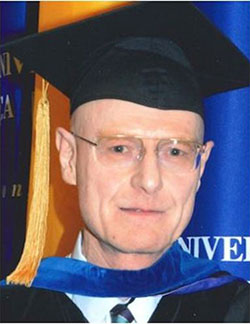
My most prestigious accomplishment has been that of being a "Fisico Normalista" from 1966 till 1970, thus receiving my Diploma di Licenza in Fisica della Scuola Normale Superiore di Pisa at only 21 years of age, thus matching in that regard (only) Enrico Fermi's performance. Concurrently, I received my Laurea in Fisica, Magna cum Laude, in the Physics Department of the University of Pisa in 1970. Then I was a National Research Council (CNR) postdoctoral fellow and subsequently a CNR researcher with a permanent position in the Department of Physics of the University of Pisa. In 1975-1976 I was an Army engineer, ranking as second lieutenant and Instructor, at the Military Academy of Cecchignola, in Rome. Then in 1977-1980, I became a NATO Senior Fellow and a Research Associate at the Department of Physics of Purdue University, West Lafayette, Indiana. Following that, I became Assistant Professor, 1980, Associate Professor, 1985, and Ordinary Professor, 2000, at the Department of Physics of The Catholic University of America, Washington, D.C.
Teaching
Since 1980, I have taught all the core courses of both the undergraduate and graduate Physics curricula at Catholic University, plus numerous advanced courses on continuum mechanics, chaotic dynamics, quantum field theory, many-body theory, relativity, and cosmology. For all of these courses, I have prepared and provided to the students extensive and detailed notes, problems, and solutions, which are still generally regarded as highly instructive.
Publications
I authored and/or co-authored more than 100 publications in prestigious journals since 1973. The three most recent ones, on which I am still building, are:
L. G. Resca, Cosmological Mass of the Photon Related to Stueckelberg and Higgs Mechanisms, Particles 2024, 7, 289-296; https://doi.org/10.3390/particles7020017; https://arxiv.org/abs/2404.00241.
L. G. Resca, “Cosmological mass of the photon and dark energy as its Bose-Einstein condensate in de Sitter space,” Indian J. Phys. 2023, 97, 605–621; https://doi.org/10.1007/s12648-022-02395-z; https://arxiv.org/abs/2006.08398.
L. G. Resca, “Minimal cosmological masses for nearly standard-model photons or gluons”, Gen. Relativ. Gravit. 52, 14 (2020); https://doi.org/10.1007/s10714-020-2663-6.