
Glove Donning Assistance Device
Students: Sonia Aregawi (BE), Nathan Ford (BE), Brian Sayah (BE), Laney Schulz (BE)
Faculty Mentor: Dr. Peter Lum
 It is essential for the protection of the clinician and the patient that medical gloves be worn in healthcare settings; however, individuals with limited hand mobility experience significant difficulty performing this task. The purpose of this project was to design a glove-donning assistance device for a first-year student at CUA with impaired hand dexterity due to a chronic condition. The student needed to be able to don gloves in under 30 seconds. Existing solutions were evaluated through benchmarking and in line with stakeholder needs. This revealed limitations in the device's size, weight, and sanitization. Many design concepts were identified, but after analysis using a weighted design matrix, a vacuum-powered glove inflation system was selected as the most effective approach. This design employs a mechanically actuated glove-loading mechanism and vacuum suction to inflate and open the glove. This inflation allows the user to insert their hand with minimal effort. Iterative testing was conducted to ensure device efficiency and to mitigate risks to the user. The current prototype demonstrates the feasibility of an automated, user-centered glovedonning system, providing a foundation for future devices and refinement towards clinical incorporation.
LEGO 3D Bioprinter
Students: Eric Corzine (CS), Allison Ewing (CS), Chase Zabala (BE), Paul Duldash (ME)
Faculty Mentor: Dr. Otto Wilson
 The main purpose of a LEGO Mindstormbased Bioprinter is to create tailored sheets of a clay/cellulose paper hybrid material, called Clayper, to be folded into accurate models for tissues and organs in the body. The clayper sheets will serve as an initial model system to demonstrate feasibility and effectiveness of the system's printing abilities and the material's pliancy and printability. The eventual idea is to bioprint viable cartilage tissue sheets - which can then be folded like origami to then be surgically inserted inbetween bones, such as in and around damaged knees, to provide cushioning usually provided by cartilage. Team LEGO's efforts have successfully developed a proof-of-concept 3D bioprinter capable of fabricating anatomically correct structures using "Clayper", the clay-cellulosebased bioink inspired by origami folding principles. The low-cost of the bioprinter design frame will allow the system to be widely accessible for classroom and educational environments. Through iterative design improvements to the syringe pump, frame stability, and material formulation, the system has demonstrated consistent material extraction and reliable printing performance. While the current printer is intended as an educational tool to introduce students to biomedical fabrication and tissue engineering concepts, it is also designed to be future-proofed for continued development toward printing more advanced biomaterial and cartilage-like constructs.
A Sensor-Integrated Scoliosis Reconfiguration Device for Compliance Tracking
Students: Maysoon Obeid (BE), Emma Wallace (BE), Anastasia Rao (BE), Ethan Justin Reyes (BE)
Faculty Mentors: Andreas Widmer, Brian Walsh
 In the United States alone, around 6-9 million people are affected by scoliosis. The current standard of care for scoliosis ranges from observation to bracing to surgery, depending on the severity of the degree of the curve within the patient’s spine. Skolios, a newly developed scoliosis reconfiguration device, aims to create an alternative method for scoliosis treatment to reduce the time, intensity, and pain induced by treatment compared to the current standard of care. In order for physicians to effectively determine the result of treatment with the Skolios system, physicians must be able to track patient compliance. We integrated an electrical system connected to a user interface into the mechanical design to provide practitioners with the capability to track patient usage. When a patient uses the device, force is applied from their hip to the hip bolster of the device. This force is detected by force sensors, and values are collected by a control board. The data flows from the control board to the Arduino software to be further directed to a REST API. The API stores and allows the data to be accessed by a user interface. The fully integrated system within Skolios enables effective treatment of scoliosis through the combination of a new alternative treatment device and reliable tracking of patient data.
Redesigning Cardinal Closet
Students: Meghan Murray (BE), Paolo Gonzales (CE), Hamad Alturki (BE), Mohamed Abdi (CE)
Faculty Mentor: Dr. Rebecca Kiriazes
 The Cardinal Closet at The Catholic University of America serves as a vital campus resource, providing free secondhand clothing to students and faculty. This initiative promotes a culture of sustainability intended to combat the negative impacts of fast fashion within the community. To improve the existing donation workflow and accessibility, this project focuses on developing a specialized "Smart Donation Drop-Off Bin". This system specifically integrates a robust structural design with sensorbased detection to enhance the efficiency of clothing collection. The mechanical design of the bin features an ADA-compliant 4ft x 2ft x 2ft frame constructed from dimensional lumber and plywood. To ensure the unit can withstand repeated loading and long-term use, the wooden frame is reinforced with X-bracing and steel connections for added strength. User interaction is prioritized through a sloped front face and a user-friendly circular chute system designed for universal accessibility. For security and the protection of contents, the bin utilizes a one-way deposit system and a lockable access door. The "smart" functionality is driven by a retro-reflective photoelectric sensor system powered by a 12V DC battery. This sensor accurately monitors the clothing fill level, triggering a redlight notification once the bin reaches maximum capacity. Integrated caster wheels allow for easy transport and repositioning of the bin across the campus as needed. By prioritizing sustainably sourced materials and a simple design for easy maintenance, the drop-off bin offers a cost-effective solution to improve the donation experience.
Smart Rainwater Harvesting System to Service the CUA Community Garden
Students: Xavier Vaglia (ME), Jack Schemel (CE), Selamawit Wondimu (CE), Ryan Wolk (CE)
Faculty Mentor: Dr. Arash Massoudieh
 SmartStorm is a system intended to serve as a smart Internet of Things System to service the public by rerouting and storing excess rainwater. Stormwater runoff could often be a downside to areas depending on how the flow of the water runs, potentially causing flooding in areas. SmartStorm is meant to help not only prevent that issue, but also service the public in an additional manner, through irrigation by serving the Community Garden. The system consists of multiple inputs varying from depth of water in a barrel, weather data, and unique to this system, moisture in soil. The weather data factor being most unique, as it’s taken from NOAA, and allows for forecast predictions, which permit our code to dictate a release or withhold of the water. The code would revolve around a valve using all given inputs such as the depth in the barrel getting too high, the soil in the garden being dry, as well as the weather factors predicting when dry periods or rainfall will occur. Factored to account for are instances such as overwatering, secondary drainage, and more, and it will be monitored when implemented to ensure a safe system as a whole. The system is intended to serve the garden and be as low maintenance as possible, and is planned to be improved through testing when the system is field implemented. SmartStorm is meant to help with general rainfall issues, yet now services the public in a much more impactful manner.
2026 AISC Student Steel Bridge Competition
Students: Mike Tyszko (CE), William Granci (CE), Andrew Holtzman (CE), Richard Suchyta (CE), TylerJade Chandler (CE), Serena Tewoldeberhan (CE)
Faculty Mentor: Dr. Jason Davison
 This project presents the design, analysis, and testing of a steel bridge developed by our team for the 2026 Student Steel Bridge Competition (SSBC). Our objective was to create a 1:10 scale pedestrian bridge that maximizes strength-to-weight efficiency while ensuring rapid constructability and compliance with competition constraints. The design supports a total load of 2,500 lbs. while minimizing deflection and optimizing material use. Our team developed a trussbased system featuring triangular stringers as the primary load-carrying members, supported by seating piers and interconnected through bolted angled connections and under-truss elements. We selected these components to efficiently transfer loads, increase stiffness, reduce deflection, and enable quick assembly. A500 steel sections and standardized bolted connections balance structural performance with constructability. We conducted finite element analysis using SAP2000 and refined the design iteratively in CAD software. To validate our work, we performed physical testing using a custom loading rig and a hydraulic pressure gauge, demonstrating strong agreement between modeled and experimental deflections. Under a 1,750 lbs. point load, the bridge exhibited just over one inch of deflection, confirming acceptable structural behavior. Overall, our design satisfies strength, serviceability, and constructability requirements while maintaining a lightweight and efficient configuration. This work highlights how our team integrated structural analysis, fabrication considerations, and hands-on testing to develop a competitive bridge for the SSBC.
Urban Data Center
Students: Brendan Foley (ME), Anderson Guerrero (CE), Samuel Hoerl (CE), Audrey Khoriaty (CE)
Faculty Mentor: Dr. Rick Thompson
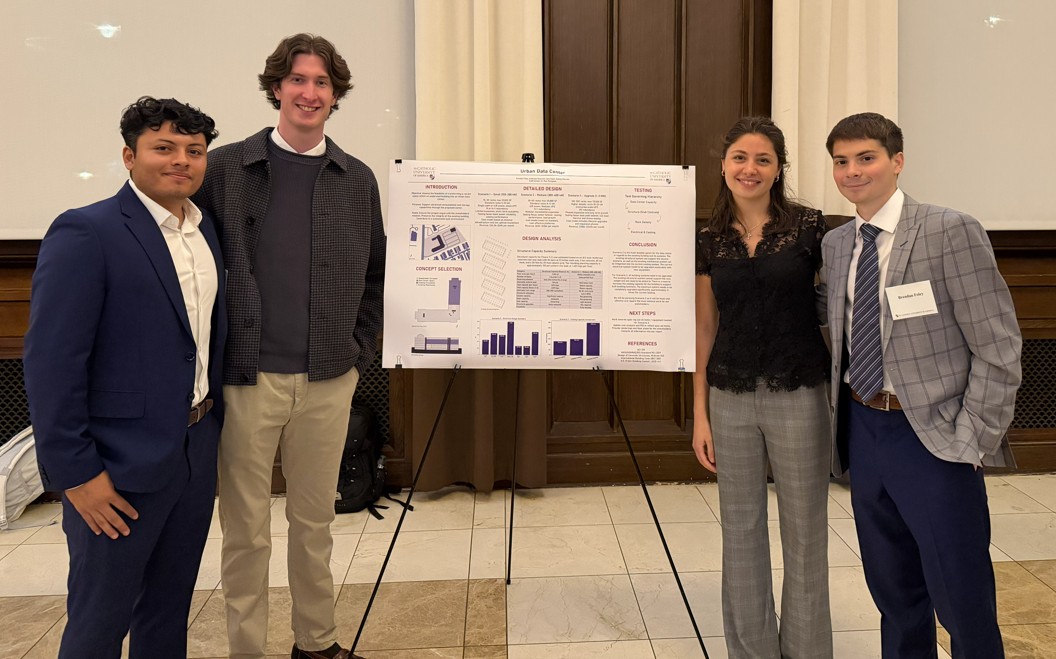 This project assesses the feasibility of converting a vacant space, within an office building, into an Urban Data Center that will hold data and storage capabilities while aligning with the mission and values of our Stakeholders. The project includes evaluating the structural capacity, spatial layout, electrical and mechanical systems to determine the building’s ability to support data infrastructure. The team conducted code and zoning analysis, and identified sustainable design strategies that minimize environmental impact. Proposed solutions include upgrades to electrical and cooling systems, flexible layouts for potential mission aligned clients, and cost and schedule estimates for feasibility. The mechanical analysis indicates cooling demand of approximately 500 tons, exceeding existing capacity, requiring expansion through additional chillers, CRAH units, and upgraded piping to support continuous data center operation. The electrical analysis estimates a total facility load of approximately 4.3 MW, requiring major upgrades including increased utility service, new switchgear, A/B distribution, UPS systems, and standby generation. Structurally, the proposed data center is feasible within the existing building framework; however, careful load distribution and localized slab analysis will be required due to increased rack densities. This study also identifies operational, financial, and energy related risks, providing our Stakeholders with a clear framework to make informed decisions regarding project viability while optimizing the return on investment.