
Contact Pressure Sensor Using Carbon Nanotube Yarns
Students: Emilia Kozeracki (Env.E), Ernesto Asuncion (ME), Christian Miraglia (ME), Nathan Miscichowski (ME)
Faculty Mentor: Dr. Jandro Abot
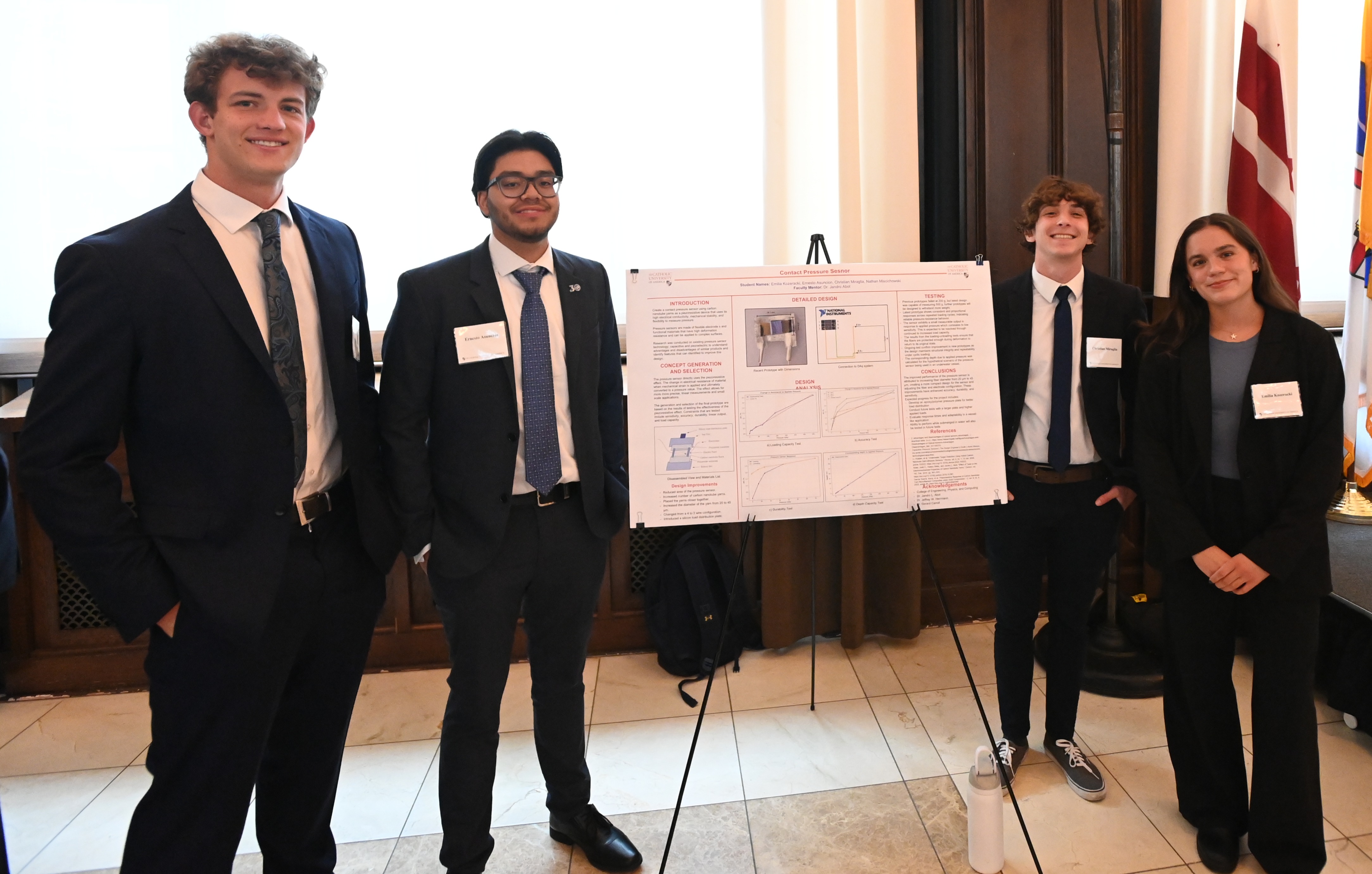 This project focused on designing and testing a contact pressure sensor that uses carbon nanotube yarns as a piezoresistive element. These yarns were chosen because they exhibit piezoresistivity and are electrically conductive, flexible and stiff enough to withhold pressure. The sensor works based on the piezoresistive effect, meaning its electrical resistance changes when pressure is applied. By measuring the electrical resistance and using the sensitivity, the pressure could be determined in each case. Several prototypes were designed, fabricated and tested using several performance criteria, including sensitivity, accuracy, linearity, depth limits, durability, and load capacity. Based on these results, multiple design changes were made throughout the process. Adjustments included the overall size, the arrangement and spacing of the yarns, the number of yarns used, the wire setup, and the design of the load distribution plate. The iterations on the design concepts relied on the robustness and sensitivity of each of them. The final design showed clear improvements, including the ability to handle higher pressure, better sensitivity, and more consistent resistance readings. All of the original design requirements were met, suggesting that the sensor is suitable for its intended use as a contact pressure sensor under various conditions. Overall, the results show that CNT yarns are a promising option for pressure sensing in demanding environments.
Cooling Cardinals: Portable Shading for Athletes
Students: James Campione (CE), Chloe Lockwood (CE), Annabelle Begley (CE), Luis Lopez De Victoria (ME)
Faculty Mentor: Dr. Jandro Abot
 The portable shading system is designed to satisfy several key stakeholder requirements, including providing reliable shade and protection for athletes while integrating a cooling system equipped with fans. To achieve the desired overall performance, the design incorporates multiple subsystems, notably structural stability, expandability, and portability. Structural stability is essential to ensure user safety, one of the fundamental priorities of the system. Expandability enables the design to accommodate various sports teams with differing numbers of athletes. Portability ensures that the system can be easily transported and deployed across multiple field locations. The shading system has been worked on in collaboration with key stakeholders from the athletics department such as, Jaime Walls and the head women's soccer coach, Casey Sommers as well as various other individuals who are a part of the facilities management team. The main location of the portable shading system will be Carlini Field and will be available for use for any other sports teams also using that field. Within our design, we have incorporated an intricate aluminum structure (Alloy 6061-T6) that will be connected through various aluminum connections and welding. The cooling factors of the design are made up of fans and a perforated vinyl covering. The fans will be powered via the solar panels located at the top of the structure and a battery pack, with the help of a power inverter. The main focuses of this project have been its structural stability, cooling effects, but also its constructability as we aim to fully construct a prototype.
Smoldering Fire Detection System
Students: Paul DiMarzio (ECE), Kerene Bomela (ECE), Brendan Noone (ME), Joseph Kennedy (ME)
Faculty Mentor: Dr. Jandro Abot
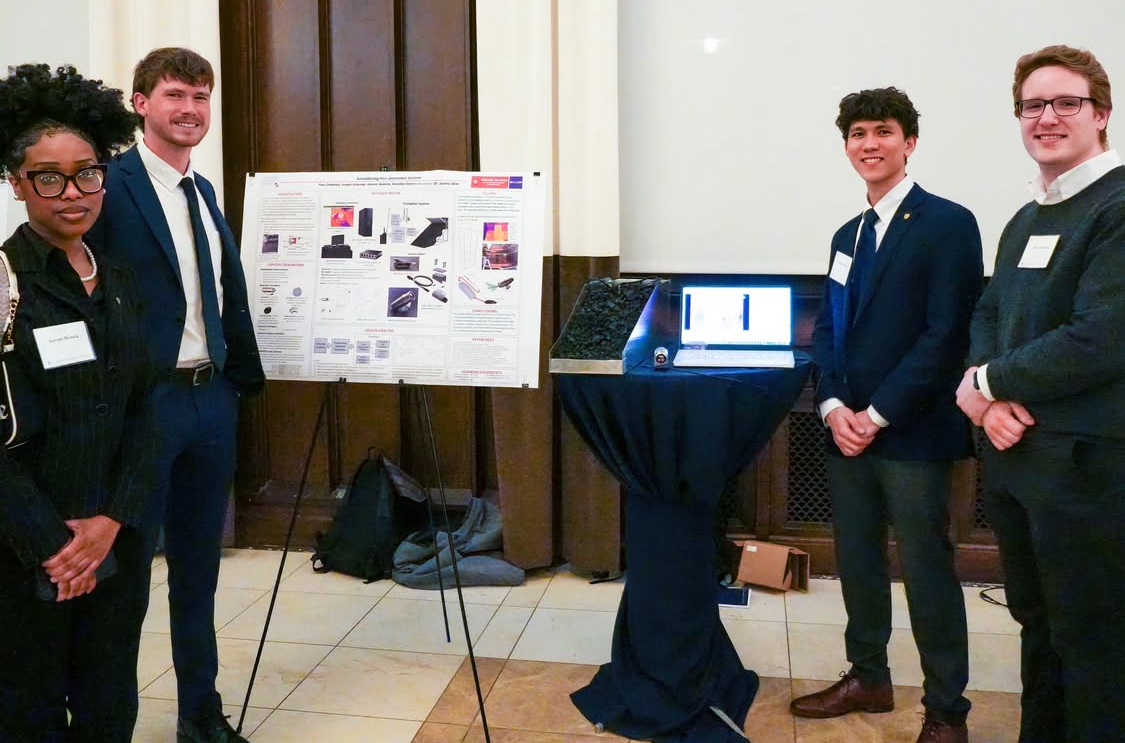 In 2024, a fire at Maryland Small Arms Range (MSAR), caused by a tracer round smoldering within a granular rubber bullet trap, resulted in over $2 million in damages and highlighted a critical safety gap: the lack of continuous thermal monitoring in indoor shooting ranges using ballistic rubber traps. This project, sponsored by WILLCOR, presents a supplementary smoldering fire detection and alert system designed to address this risk. Indoor ranges are particularly vulnerable to subsurface fires initiated by thermal and tracer rounds, while conventional detection methods are often ineffective due to environmental constraints or delayed response times. The system employs an Optris Xi 400 radiometric thermal camera to continuously monitor bullet trap surfaces, detecting and localizing persistent hotspots indicative of early-stage smoldering events. Thermal data is processed through custom software running on a workstation, providing real-time temperature visualization, historical trend analysis, and multi-camera support via a Power over Ethernet (PoE) network architecture. The software identifies sustained temperature increases above defined thresholds and initiates a multistage alert process, issuing email and text notifications with thermal images, hotspot location, and measurement data to range personnel. Designed for continuous 24/7 operation, the system incorporates reliability features including a watchdog process and uninterruptible power supply, and has been validated using a controlled testbed simulating subsurface heat sources. The resulting system offers a reliable, cost-effective, and scalable solution for improving fire prevention and safety in indoor shooting facilities.
Small Boat Stabilization
Students: Mary Kiechlin (ME), Nolan Scott (ME), Brienna Spano (BME), Grant Wicks (ME)
Faculty Mentor: Dr. Gerard Carroll
 The Small Boat Stabilization Project investigates methods to reduce roll motion of a small boat operating in open water to improve crew working conditions and mitigate seasickness. The proposed design consists of a passive stabilization system suspended from each side of the vessel, utilizing a spring-mass-damper system. The primary objective of experimentation is to reduce the amplitude of the system’s resonance frequency through variation of the attached mass. The system is composed of elastic cords acting as the spring, a hydraulic damper to dissipate energy, and aluminum plates serving as adjustable masses. Assembly of our system includes rope and clamps to attach each component and to attach the system to the boat. Experimental testing was conducted for the spring constant (k) of the elastic cords and the damping coefficient (c) of the hydraulic damper. The transfer function relates the vertical output motion of the system with the vertical input motion of sea waves, which affects the roll of the boat. The previously calculated parameters (k and c) allowed for the determination of the value for the attached masses. MATLAB simulations were conducted to evaluate the effects of our system of the boat’s motion, which allowed for a decrease in the amplitude of resonance frequency in sea state 3 conditions. Further dynamic and field testing are necessary to assess the system’s practicality and operational viability.
Adjustable Spiral Acoustic Array
Students: Ariel Wise (ME), Everth Rivera (ME), Nicolas Coreas (ME), Aidan Kayal (CE)
Faculty Mentor: Dr. Gerard Carroll
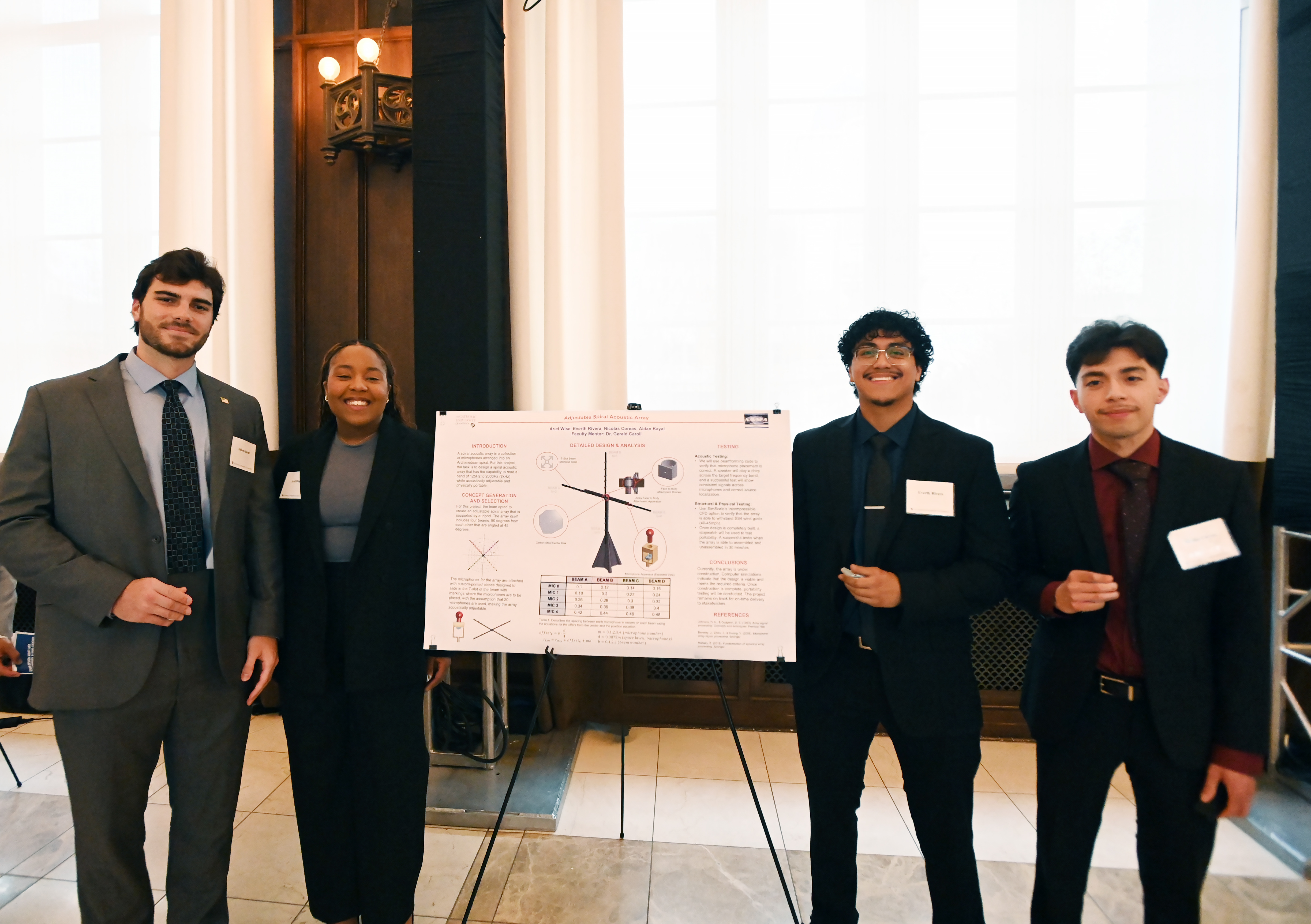 For decades, acoustical research has remained a continually evolving field with significant applications in both academia and defense. This project, an adjustable spiral acoustic array, aims to support acoustical researchers by providing a versatile and adaptable testing platform capable of accommodating multiple experimental parameters. The primary objective of this project is to develop, design, and fabricate an adjustable spiral acoustic array that can capture low-frequency broadband signals (125 Hz to 2000 Hz) through adjustable microphone placement, while maintaining ease of portability and deployment. To develop and design this project, advanced modeling and simulation tools, including OnShape, SimScale, and SolidWorks were used the verify the structural ability of at the array. In the design and development stage, MATLAB was utilized the verify acoustic hand calculations for microphone placement and spacing. To fabricate the array and its subsequent parts, a combination of 3D printing and CNC machining were used. Testing and simulation results indicate that the array meets key stakeholder requirements including structural stability in winds as large as SS4 (40-45mph), resistance to water exposure, and easy portability.
Trolley Museum Autorailer
Students: Tristan Burrola (CE), Grace Dirkin (ME), Jonathan Gonzalez (ME), Paul Lacava (ME)
Faculty Mentor: Dr. Gerard Carroll
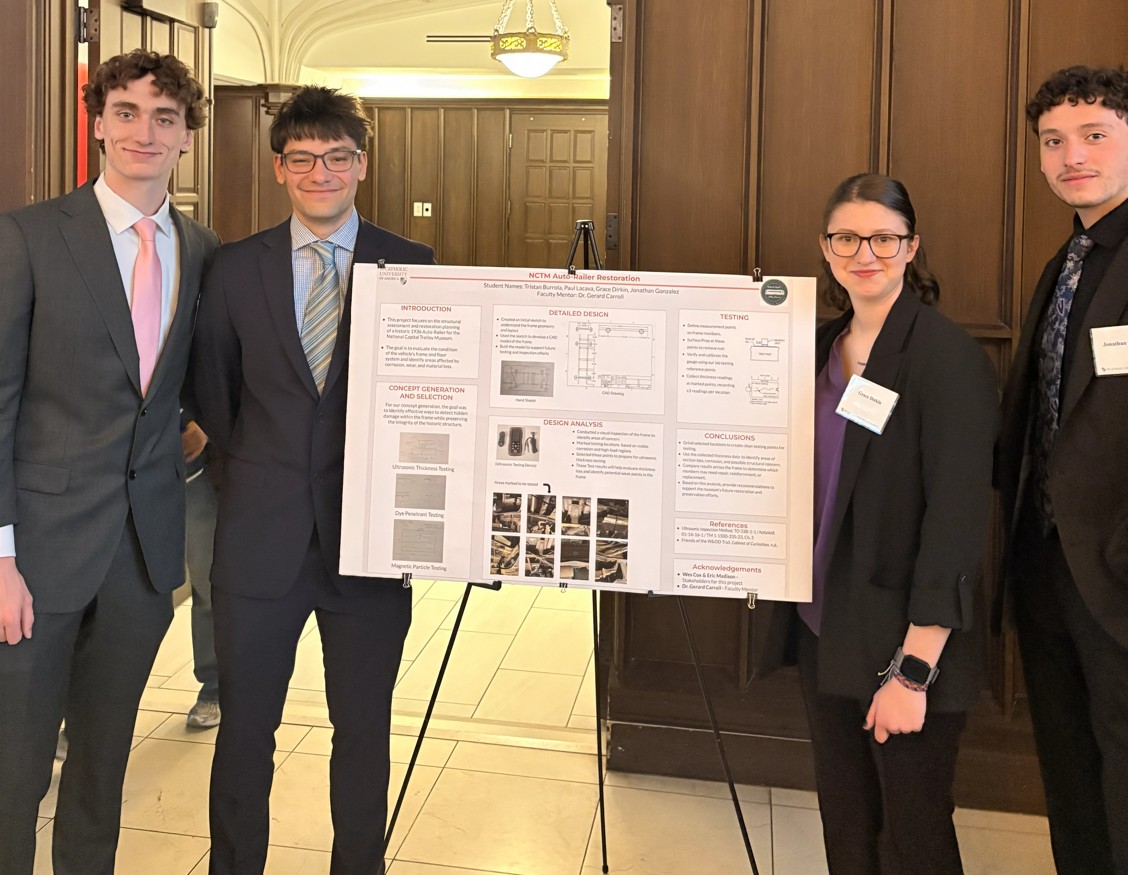 The focus of this research is the structural assessment of a 1936 Auto-Railer located at the National Capital Trolley Museum with respect to its steel frame and floor structure. In particular, the objective of the work is to assess the current state of the steel components and determine which areas need to be restored. As the object is old and subjected to corrosion, it becomes essential to use non-destructive testing methods. In order to perform the assessment, the technique of ultrasonic thickness testing (UTT) will be employed. Specific areas for testing will be defined after conducting a preliminary visual examination to determine corroded areas and those subject to larger loads. Before performing tests, surface preparation will be carried out in each selected area, and several measurements will be conducted. Obtained information will serve to create maps of thickness distribution in relation to section loss and pitting. In parallel, a hand sketch and CAD model of the frame were developed to better understand the geometry and support data visualization. These models allow for the integration of test results into a structural condition map. The findings from this study will inform recommendations for repair, reinforcement, or replacement of specific frame members. Ultimately, this project provides a data-driven approach to restoring a historic vehicle while maintaining structural safety and historical integrity.
Ground Effect Radio-Controlled Airplane
Students: Katelyn Anderson (ME), Joseph Allard (ME), Christian Polking (ME), Herman Sandhu (ME)
Faculty Mentor: Dr. Diego Turo
 The aim of this project was to design, construct, and fly a radio-controlled airplane that utilizes the ground effect for the entire duration of the flight. The ground effect is an aerodynamic phenomenon that impacts an aircraft during the phases of takeoff and landing. When the wings are at less or about one wingspan from the ground, vortices that form at the tips of the wings during the flight are reduced. The absence or weakening of these vortices reduces the drag and increases the lift making the flight during these phases more efficient. Our team designed the airplane so that it would use the ground effect for the entirety of its flight time. This was achieved by designing wings with long chord (20 in) and a short wing span (44 in), designing a wider elevator (30 in) and using two motors to increase maximum thrust. The airplane has 16 in long rudder, a 54 in long fuselage, it uses strakes at the wings’ tips and has interchangeable landing gear for testing on land (wheels) and water (floats). The control surfaces as well as the tail wheel/float are controlled by servo motors. The aircraft is made out of lightweight and cost-effective materials, mainly consisting of foamboard, XPS foam, wood, and carbon fiber. Various glues were used for construction to maintain sturdy connections and create seals. Flight tests were utilized to determine flight performance, stability and responsiveness of the aircraft.