
Designing a Direct Methanol Fuel Cell with Electrofabricated Chitosan Membranes
Students: Christopher Crognale (ME), Sean Farrelly (BE), Michael Maloney (ME), Henry Ogden (ME)
Faculty Mentors: Dr. Xiaolong Luo, Dr. Chuan-Fu Lin
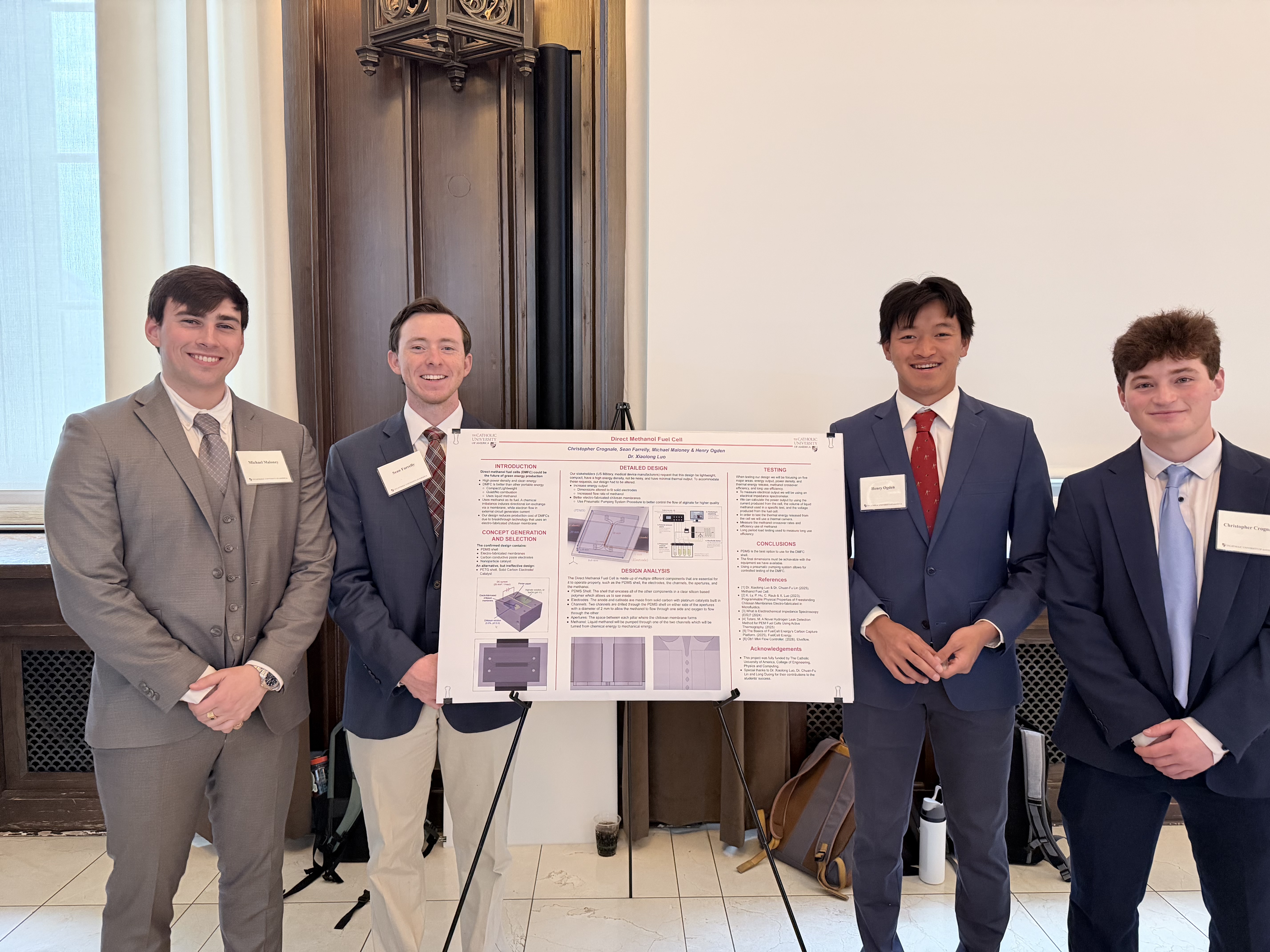 This project develops a direct methanol fuel cell (DMFC) that uses a biodegradable chitosan membrane and low-cost non-platinum-group-metal (non-PGM) catalysts. Hydrogen fuel cells have played an essential role in NASA explorations by converting chemical energy directly into electricity with high efficiency, light weight, and long duration. However, adoption of hydrogen fuel cells is limited by high costs and the need for infrastructure for hydrogen production, storage, and distribution. DMFCs offer an infrastructure-ready alternative that uses liquid methanol with an energy density half that of gasoline. However, traditional DMFCs use costly proton exchange membranes (Nafion) and noble-metal catalysts, which hinder scalability. This design incorporates chitosan, a derivative of the 2nd naturally abundant biopolymer chitin, as the alkaline anion exchange membrane (5-20% Nafion cost) and uses non-PGM catalysts (5-20% precious metal cost) with favorable ionic conductivity, superior fuel logistics, reduced methanol crossover, and compatibility with electrofabrication methods innovated at CUA. The system oxidizes methanol at the anode and reduces oxygen at the cathode, producing electricity, water, and carbon dioxide; chitosan facilitates ion transport and limits fuel crossover. The fuel cell stack and housing are 3D printed and integrated with graphite electrodes, emphasizing material selection, geometry, and manufacturability. The first working chitosan-based DMFC prototype delivers a peak voltage of 0.5 V and a power density of 0.24 mW/cm^2. More performance metrics will be experimentally tested and compared to commercial benchmarks. Future study will optimize device design, ion conductivity, and reaction kinetics to improve power output.
Radar Testbed with Synthetic Aperture Radar
Students: Sean Morgenstern (ECE), Harrison Blahunka (ECE), Joseph Sypal (CS), Michael Short (ME)
Faculty Mentors: Dr. Sergio Picozzi, Prof. Kevin Russo
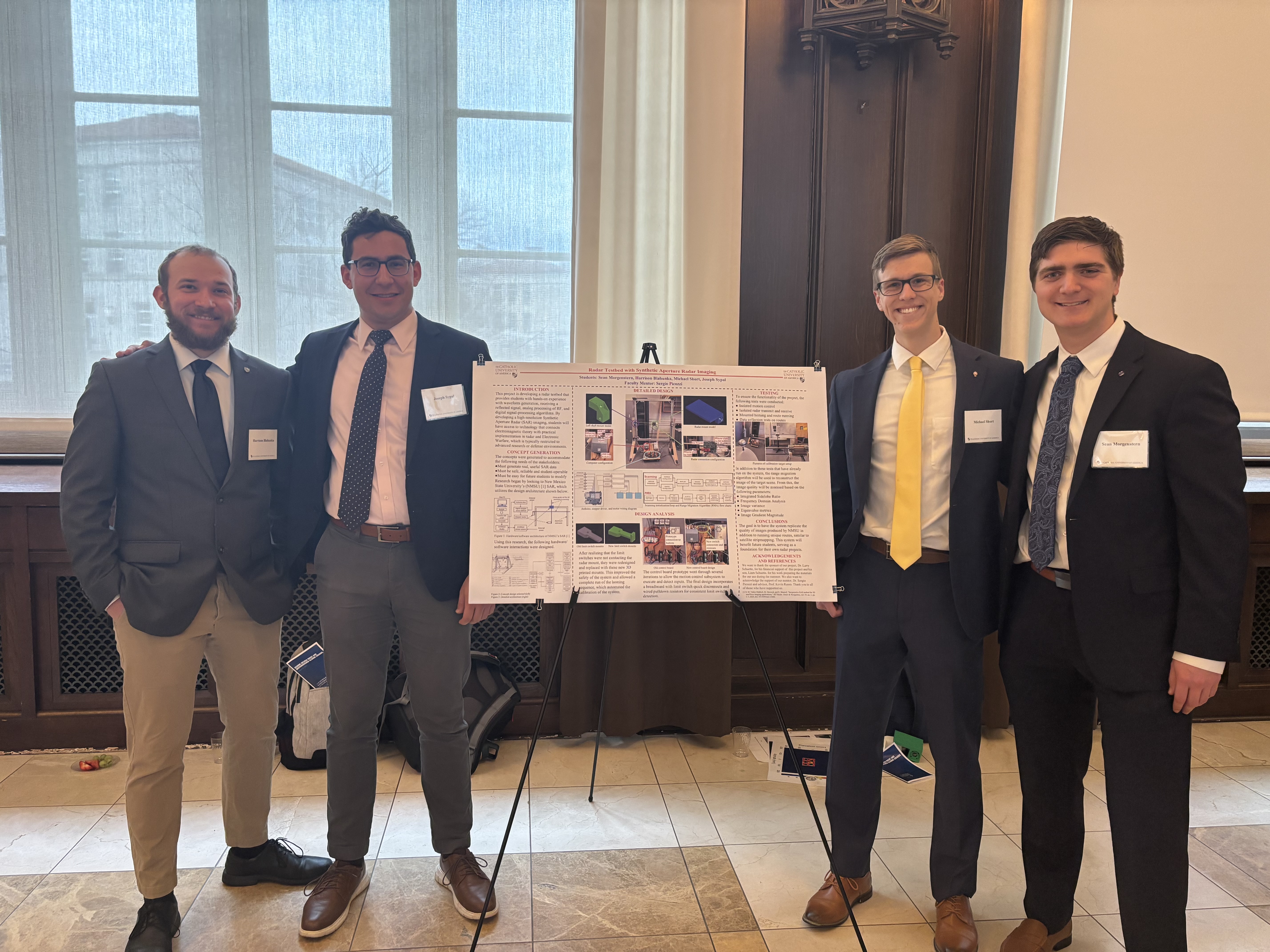 In this paper, the authors developed a scalable radar testbed with Synthetic Aperture Radar (SAR) imaging by physically moving a transmitter to simulate aerial imaging across target scenes. This low-cost platform exposes students to technology, typically restricted to advanced research or defense environments, that safely connects electromagnetic theory with practical hardware and software implementation. By referencing S M Yahea Mahbub et al.’s SAR design with the New Mexico State University (NMSU) and after multiple testing phases, the authors developed a design to minimize the issues recognized in the NMSU SAR and could replicate the image quality results with more path options over a target scene. This was done by basing the system’s physical stability on a 3D printer’s structure to minimize microdoppler due to horizontal oscillations and decrease the delay between moving to a position and scanning. The materials for the frame were also selected to minimize vibrations, yet supply stability. Incorporating modular code, a GUI with prompts and displays of scanning routes, and limit switches on the frame ensures that first-time users can safely acquire the data they desire. The radar transmitter used a frequency‐modulated continuous wave chirp on 60-64 GHz and uses a Range Migration Algorithm to generate images of the scene from the data collected. These images are then compared to objective measurements of image quality to determine how clear the acquisitions are. This testbed now serves for student research and experience with signal processing and image generation.
Seeing Through Smoke
Students: Cody Bosak (ECE), Marci Rose Brown (ME), Mathew Joseph (ECE), Luis Ignacio Pinero-Koyama (CE)
Faculty Mentor: Dr. Gregorio Toscano
 This design project focuses on the development of an advanced navigation and situational awareness system to assist firefighters operating in hazardous environments. Firefighters often encounter conditions where visibility is severely limited due to dense smoke, flames, and debris. These conditions not only slow down their ability to locate victims and fire sources but also increase the risk of injury or disorientation. The thermal camera mounted on the mask/ helmet feeds directly into a HUD inside the mask, giving the firefighter a clear forward thermal view with simple overlays. The intended purpose of the proposed system is to integrate sensing, visualization, and communication technologies that will allow firefighters to “see” through smoke, navigate efficiently, and maintain awareness of their surroundings. By combining thermal imaging, a real-time display interface, gps location, and possible haptics, the system aims to enhance firefighter safety, improve rescue efficiency, and reduce the risks associated with low-visibility operations.
Trustworthy Catholic AI
Students: Ricardo Trujilo (CS), Fernanda De La Fuente (CS), Nathaniel Barish (ECE), Sujar Henry (CS)
Faculty Mentor: Dr. Dominick Rizk
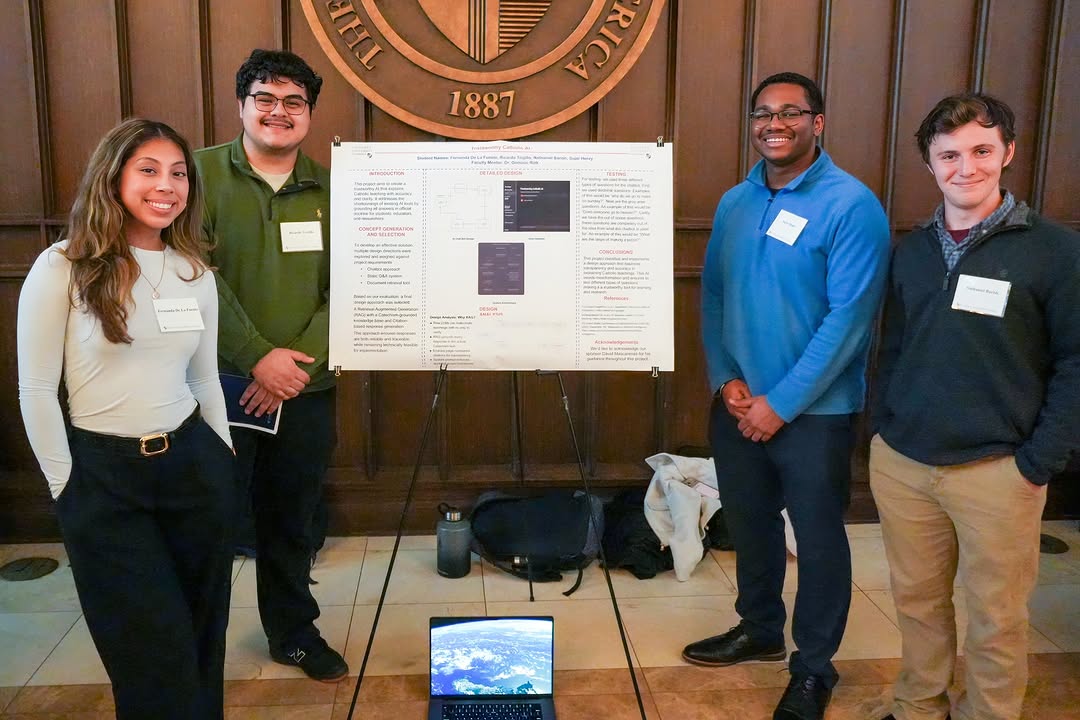 This project presents the design and development of a Catholic AI chatbot aimed at providing clear, reliable, and doctrinally accurate guidance on Catholic teaching. The system addresses the need for accessible, trustworthy resources for students, educators, and individuals seeking answers grounded in the 1993 Catechism of the Catholic Church and other authoritative Church documents. Leveraging GPT-based large language models, the chatbot integrates a retrieval-augmented generation workflow that references official texts and provides transparent reasoning for each response, allowing users to understand not only the answer but also the theological and logical basis behind it. The design emphasizes accuracy, clarity, usability, and traceability, ensuring that outputs are doctrinally faithful and easy to comprehend for users with varying levels of theological background. Stakeholder feedback guided feature selection, highlighting the importance of balancing system speed, reliability, and user-friendly interaction. Development focused on modular architecture, iterative reasoning loops, and a robust document retrieval pipeline to maintain consistency and prevent doctrinal errors. The system is built to handle complex theological queries responsibly, applying formal reasoning and structured verification processes to ensure alignment with Catholic doctrine. By combining advanced AI techniques with domain-specific knowledge, particularly the structured content of the 1993 Catechism, the Catholic AI system provides a sustainable, open-source platform for educational use, theological study, and future research in specialized AI applications.
A Practical Framework for Reverse Engineering IoT Devices
Students: Katelyn Toto (ECE), Hector Vega Bertol (CS), Maria Camargo Useche (CS)
Faculty Mentor: Dr. Dominick Rizk
 This project establishes a systematic framework for reverse engineering IoT devices, developed through independent research and refined during a case study of the Amazon Echo Dot (2nd Generation). The primary objective of this research was to document the technical stages of the reverse engineering process to develop a comprehensive, accessible framework designed for amateur and entry-level researchers. The objective was to translate professional methodologies into an accessible, seven-phase life cycle: (1) Reference Material, (2) Preparation & Imaging, (3) Hardware Exploration, (4) Data Extraction, (5) Analysis, (6) Testing, and (7) Documentation. The framework's technical steps were verified through the physical analysis of the Echo Dot, involving the identification of the Samsung eMMC chip, controlled-heat extraction, and raw binary capture in a Linux environment. Using Ghidra, the team deconstructed three binaries that produced network encryption. This hands-on application allowed the team to refine the framework's procedural logic from a theoretical model into a proven, repeatable guide. To ensure technical validity, the framework was rigorously tested by industry professionals at Two Six Technologies and CUA. Reviewers rated fifteen targeted questions across all sections, evaluating the clarity of safety protocols, terminal command compatibility, and the accuracy of software analysis workflows. By validating the framework's replicability, these experts confirmed its utility for entry-level researchers. The final deliverable is an expandable, user-friendly static website that hosts the perfected framework. This resource provides a verified, scalable foundation for future IoT security investigations and modular expansion.
A Reverse-Engineered Hybrid Voice Command System
Students: Hussam Almofarreh (CS), Jasmin Guadarrama (CS)
Faculty Mentor: Dr. Dominick Rizk
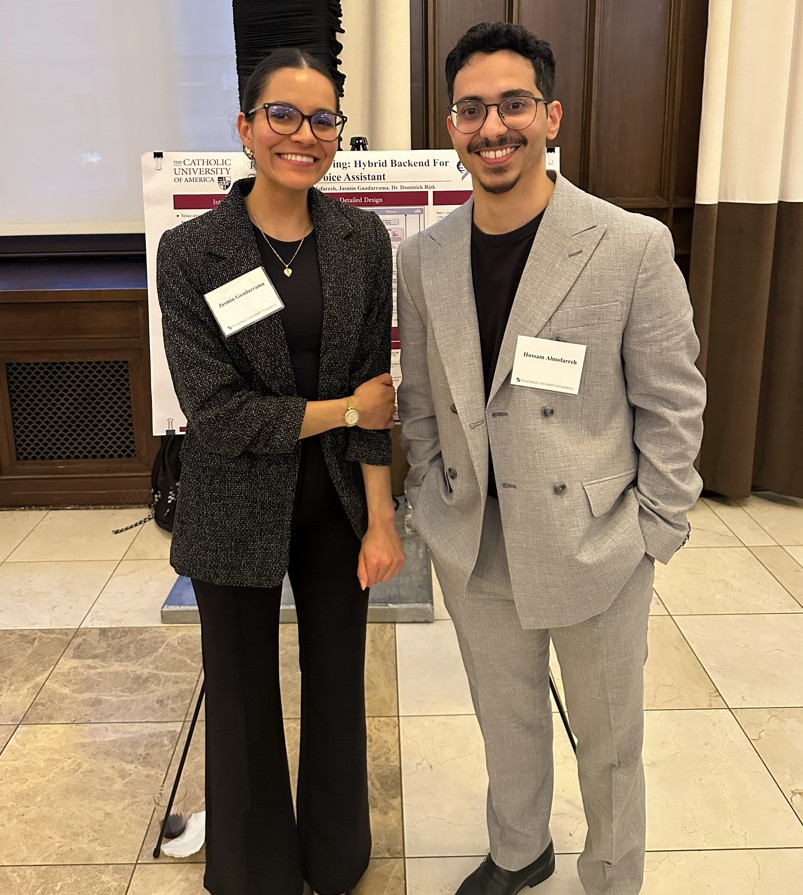 This project presents a hybrid voice command system that has been implemented in order to achieve a balance between low latency, high accuracy, and user privacy. This system was created by reverse-engineering modern voice assistants to find out their key traits like modular pipelines and use of hybrid local/cloud processing. The system processes user speech through a pipeline consisting of audio validation, preprocessing, speech-to-text (STT), natural language understanding (NLU), and response generation. A lightweight local STT model (Vosk) is used for fast, local, offline transcription. To improve performance in noisy or low-confidence conditions, a confidence-based fallback layer dynamically routes audio to a cloud-based STT service (Whisper API), providing more accurate transcription when needed. The transcribed text is then processed using a BERT-based NLU model to classify user intent and extract relevant entities, enabling structured interpretation of voice commands. Responses to the commands are generated according to the identified intents and action slots. By combining insights from reverse engineering with practical system design, the project demonstrates how integrating local and cloud-based processing improves both efficiency and robustness. Testing results show improved transcription accuracy under challenging conditions while maintaining responsiveness for clear inputs. The system also includes graceful degradation when cloud services are unavailable. This project highlights the effectiveness of applying reverse-engineered architectural patterns to build scalable, reliable, and cost-efficient voice interaction systems.